
Covington County Tax Record Layers
Covington County property tax records tie every parcel to its assessed value, tax class, exemptions, and district. They also connect the bill and payment status. You can search Covington County property records by address, owner name, parcel number, or PPIN to pull the assessment. Then turn to separate county and state sources for payment and forfeiture questions. Mississippi rules explain how true value becomes assessed value. The rules also cover when an owner may contest the roll. Keep the tax year and parcel key with every result. Confirm unclear figures with the office that maintains that layer.
| Field | What It Shows | Where |
|---|---|---|
| True and assessed value | Full-value basis and the statutory percentage used for tax | Assessor roll and DOR rules |
| Land and improvements | Separate land and building value fields | Assessor/GIS card |
| Homestead and exemption code | Relief or classification shown for the parcel | Assessor files |
| Bill and payment | Tax owed, transaction, and receipt status | Tax Collector |
| Sale or forfeiture | Tax-sale record or state-held land status | Chancery Clerk or Secretary of State |
The assessor's parcel schema includes fields like `TAX_DIST`, `EXEMPT_COD`, `HOMESTEAD`, `LAND_VAL`, improvement values, acreage, owner, situs, and deed references. Those fields add context. Still, a displayed `TOTALVALUE` should not be labeled true, assessed, or taxable value. The assessor must confirm what it means first. A tax bill is not a sale-price record either. Mississippi applies a class ratio and local millage to the value used for assessment.
Search Covington County Tax Fields
The official Covington County assessor search offers several routes into the same roll. Start with the most stable key you have. PPIN often works well when street spelling or rural situs data is weak. The page covers tax years from 2019 through 2026. Record the chosen year with every result.
| Search control | Input | Practical use |
|---|---|---|
| Name | Last, first, or company | Find owner or entity records |
| Address | Street number and name | Locate a known situs |
| Parcel Number / PPIN / BPPIN | Identifier | Cross-check map and tax files |
| Account | Account key | Reopen a known tax record |
| Subdivision | Dropdown choice | Group platted parcels |
Search Terms accepts optional text up to 100 characters. If the web result fails, call or visit the Tax Assessor with the owner, parcel number, PPIN, legal description, and tax year. A narrow written request under the Mississippi Public Records Act can also work. It can seek a public assessment card, class, land and improvement values, exemptions, tax district, and millage information.
How Covington Assessments Become Tax
The Mississippi Department of Revenue appraisal rules separate true or market value from assessed value. Class I single-family owner-occupied residential property uses a 10 percent ratio. Other real property in Class II generally uses 15 percent. Utility property and vehicles sit at 30 percent, and personal property generally uses 15 percent. The state formula runs true value multiplied by the class ratio, then assessed value multiplied by millage.
- True value
- The assessor's estimate of full market value under state appraisal rules.
- Assessed value
- The portion produced after the statutory class ratio is applied.
- Millage
- The local levy applied to assessed value to calculate tax.
- Tax lien
- A claim tied to unpaid property tax, distinct from the ordinary annual assessment.
Real property must be revalued at least once every four years. The assessor may physically inspect it without an interior look. These county tax records reflect mass appraisal, not a private appraisal of what one buyer might pay.
Look Up Covington County Tax Bills
Assessment and payment are separate steps. Use the roll to establish the parcel and tax year. Then move to the county-linked payment service for transaction status. The IBC tax payment portal handles real-property and personal-property tax payments, but it is not a public title search or a complete archive of old bills.
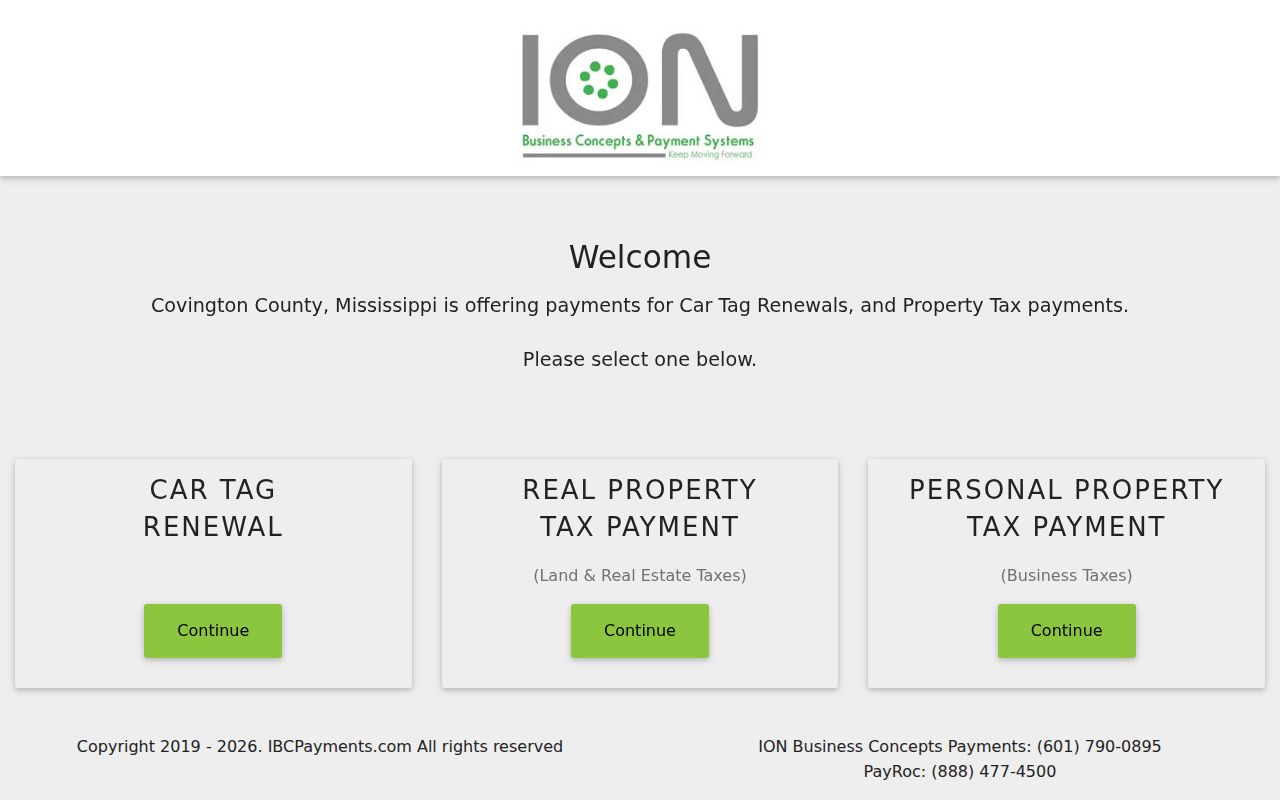
The payment screen keeps the transaction route and service-fee notice separate from the assessor's valuation search.
- Search the assessor by address, parcel number, PPIN, owner, or subdivision and select the correct tax year.
- Save the displayed parcel key, owner, class, value fields, tax district, and exemption code.
- Use the payment portal for the current transaction. Its nonrefundable service fee is 3.75 percent, with a $3.75 minimum.
- For a disputed payment, request the receipt or ledger from the Tax Collector. Ask the Chancery Clerk about any tax-sale record.
- Homestead exemption
- Relief tied to qualifying ownership, use, and occupancy of a primary home.
- Payment ledger
- The collector's record of charges, receipts, and balance for a tax account.
- Tax sale
- The county process that may follow delinquency; it is not the same as the annual roll.
- Tax forfeiture
- Land held for disposition by Mississippi after the relevant delinquency and sale process.
A confirmation email only proves an online tax bill payment was submitted for a Covington County parcel. It does not settle title or delinquency questions. Keep it on file with the parcel number and tax year for reference.
Covington County Homestead Records
The county Homestead Worksheet is a preparation sheet, not the application itself. It tells an owner to bring the deed or closing papers to the assessor. Intake fields cover the owner and spouse, mailing and physical addresses, prior owner, deed dates, purchase terms, vehicle tags, and proof of age or disability status. Sensitive identifiers and proof should go to the office. Never post them publicly or in a shared parcel note. Mississippi's homestead rules set a January 1 through April 1 filing period. The home generally must be owned and occupied as the primary residence on January 1. Regular credit can reach $300. Age or disability treatment applies to the first $7,500 of assessed value. Changes in ownership, use, occupancy, or description can require a new application.
Note: An exemption code changes taxable treatment; it does not revise the property's deed, parcel boundary, or sale price.
Covington Tax Sale Search Routes
Unpaid Covington County property tax can move through more than one record system. The collector handles delinquency and county payments. The Chancery Clerk maintains tax-sale records. Land that becomes state-held can appear in the Mississippi Secretary of State tax-forfeited search. That search is narrower than a list of every unpaid parcel. The state search accepts county, address, and subdivision. It also takes parcel number, PPIN, assessed owner, legal description, market-value range, section, township, and range. It offers contains or exact controls plus details, printing, saved-property, and auction actions. Results appear ten at a time. Status changes. So save the date, exact query, parcel key, and the office you contacted for confirmation.
Covington's 2024 Assessment Baseline
Most counties never publish one clean set of countywide totals. The DOR FY2025 annual report is the exception. It counts 17,215 Covington parcels for the 2024 assessment. The scale is striking: $90,997,383 in total assessed value, $743,665,424 in true value, and 255,935 taxable acres. Later county reports can be measured against those figures. They say nothing about one parcel's price, a city trend, or next year's values. The official Tri-State Covington resource page carries an Effective Year 2026 label for assessor-facing work. That label describes the resource rather than the 2024 totals. It also organizes the county's tax channels well.
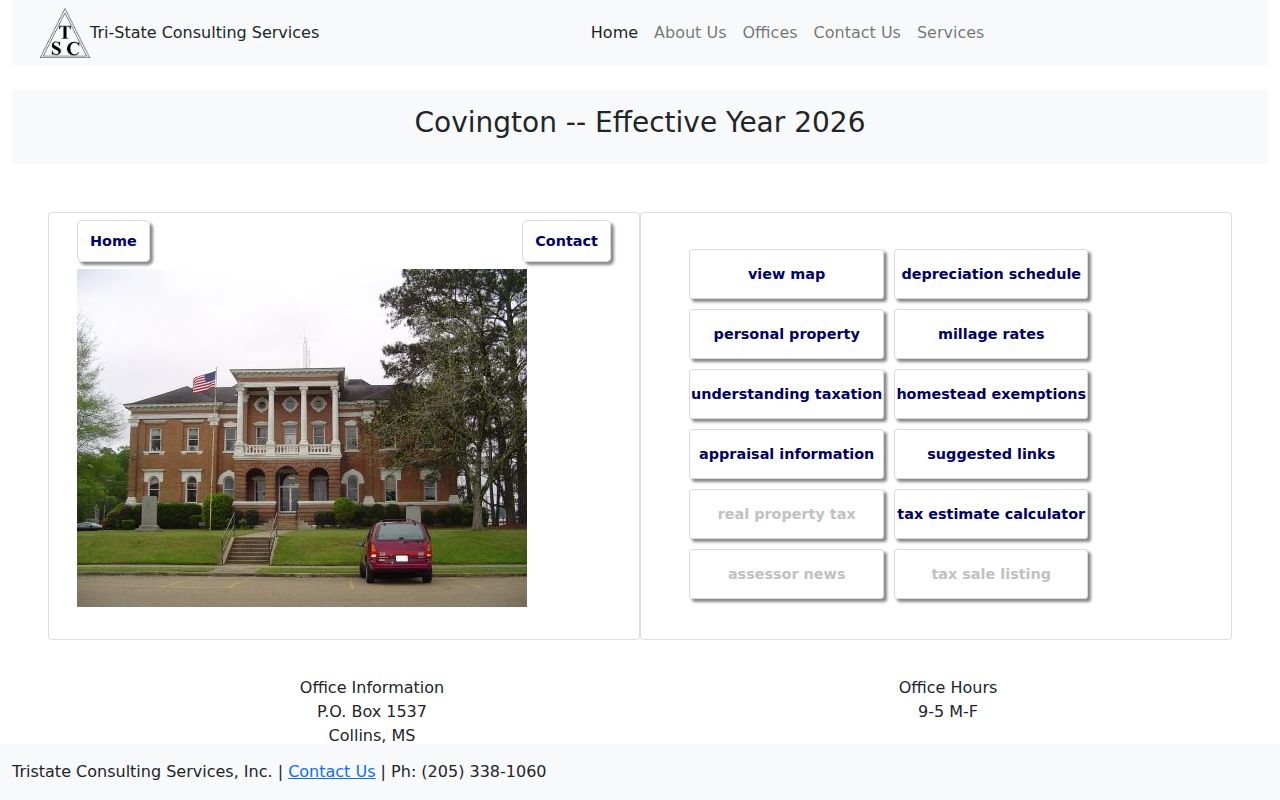
Each channel answers a different question. Appraisal, payment, homestead, millage, and tax-sale matters each live in their own records, and the page's links make that division plain.
January Roll Timing in Covington County
Mississippi taxes property to the January 1 owner of record. Bills go out in November or December, and payment falls due the following February 1. The prior owner can still anchor that tax year's records. No official Covington source publishes a fixed day count. A recorded deed's arrival in the assessor roll and GIS map layers simply varies. After a recent closing, rely on the recorded deed first. Confirm at the courthouse. Property tax records then work best as a tax-year cross-check. They should not serve as proof of current ownership. The daily-update statement on the Chancery land index covers that deed index alone. It does not cover the assessor roll.
Contest a Covington County Assessment
Covington County appeals go to the Board of Supervisors. Mississippi DOR sets the usual deadline at the first Monday in August before the tax becomes due. The county publishes no current form, filing counter, fee, evidence format, or hearing calendar for appeals. Ask the Tax Assessor or the Board for that year's exact instructions before filing.
Good records make the case. Save the notice, tax year, PPIN, parcel number, owner name as shown, situs, legal description, classification, land and improvement values, exemption code, and tax district. Support can include the recorded deed. Add the parcel card, photos, an inspection report, comparable evidence adjusted for date and condition, and flood or land-use documents. GIS acreage is context. It is not survey proof.
Confirm the deadline. Mississippi's normal deadline is the first Monday in August, but obtain the current Covington County instructions before relying on that date.
A public-record request can seek the public assessment card. Current appeal materials can be requested the same way. Under Miss. Code §25-61-7, ordinary search, review, copy, and mailing fees may not exceed actual cost, while a separate reasonable-fee rule governs GIS or cadastre data. Some appraisal working papers stay restricted, so name the precise public fields you need.